Ready to level up your grow game?
If you’re serious about maximizing yield, dialing in your plant count, and eliminating guesswork, feminized cannabis seeds are one of the smartest tools in your arsenal. But here’s the big question: how are feminized seeds actually made, and what does that mean for your grow?
In this ultimate guide, we’re breaking it all down. Genetics. Hormones. Myths. Real-world grower impact. Let’s dive in.
What Are Feminized Cannabis Seeds?
Let’s start simple.
Cannabis is a dioecious plant, meaning it grows as either:
- Male (XY) – produces pollen
- Female (XX) – produces resin-rich flowers
With regular cannabis seeds, you’re flipping a coin. Roughly 50% male, 50% female.
Feminized cannabis seeds are bred to produce nearly 100% female plants. That means no surprise pollen sacs and no wasting weeks growing plants you’ll eventually remove.
For growers with limited plant counts, that’s huge.
The Science: How Feminized Seeds Are Made
Here’s where things get interesting.
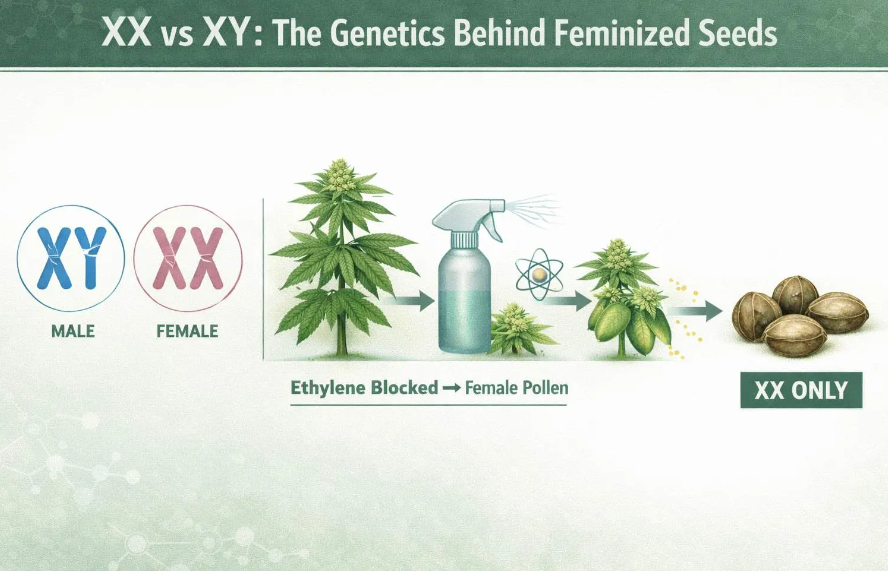
Feminized seeds are not GMOs. There’s no foreign DNA and no gene editing. Instead, breeders use controlled hormonal manipulation to influence how the plant expresses its sex.
Step 1: Understand the Genetics
- Female plants = XX
- Male plants = XY
If pollen contains only X chromosomes, then every resulting seed will be XX, female.
So how do you get X-only pollen?
Step 2: Force a Female Plant to Produce Pollen
Breeders temporarily block a hormone called ethylene, which is responsible for female flower development. When ethylene is inhibited, a genetically female plant forms pollen sacs instead of pistils.
The pollen produced is genetically female.
When that pollen fertilizes another female plant, the seeds produced are exclusively XX.
That’s the entire system.
Methods Used to Create Feminized Seeds
Professional breeders rely on controlled techniques. Here are the main options:
1. Colloidal Silver
A silver-based solution sprayed on a female plant during early flowering. It blocks ethylene production and triggers pollen sac formation.
Reliable and widely used.
2. Silver Thiosulfate (STS)
A more stable and commercially preferred method. STS blocks ethylene receptors more consistently than colloidal silver.
Most high-quality feminized seeds today come from STS programs.
3. Rodelization (Old School)
This involves stressing a female plant by leaving it unharvested past maturity. It may produce a few male flowers as a survival response.
Less predictable. Rarely used by serious breeders today.
Why Feminized Cannabis Seeds Dominate Modern Grows
Let’s talk real grower advantages.
1. Maximize Your Plant Count
In Canada, most households are federally allowed up to four plants (province rules may vary)
If two turn out male? You just cut your potential harvest in half.
Feminized seeds make every plant count.
2. No “Sexing” Phase Stress
With regular seeds, you wait 4–6 weeks watching for pre-flowers. Miss one male plant and you risk pollinating the entire grow.
Feminized seeds eliminate that guessing game.
3. Better Resource Efficiency
No wasted:
- Soil
- Nutrients
- Electricity
- Veg time
Every plant you nurture is a productive one.
4. Ideal for Indoor Grows
Grow tents, hydro systems, and SCROG setups all benefit from uniform female crops. Feminized seeds help keep your canopy consistent.
Challenges: What Growers Should Still Watch For
Let’s keep it real. Feminized doesn’t mean foolproof.
1. Stress Still Matters
Any cannabis plant, regular or feminized, can show intersex traits under severe stress:
- Light leaks during flowering
- Major temperature swings
- Nutrient toxicity or deficiency
- Physical damage
Stable environment = stable plants.
2. Not Ideal for Breeding
If you’re creating new strains, you need true male genetics. Regular seeds are still king for breeding projects.
Feminized seeds are designed for flower production, not genetic exploration.
Feminized vs Regular vs Autoflowering: Clear Comparison
Let’s lock this in.
Regular Seeds
- 50/50 male or female
- Essential for breeding
- Requires plant sex identification
Feminized (Photoperiod) Seeds
- Nearly all female
- Flower when light shifts to 12/12
- Full control over veg time
Autoflowering Seeds
- Often feminized
- Flower based on age (3–4 weeks)
- Faster lifecycle
- Usually smaller plants
Feminized refers to sex. Autoflower refers to flowering trigger. They are separate traits.
Step-by-Step: Growing Feminized Cannabis Seeds
Ready to run a clean feminized grow? Follow this system:
Step 1: Germinate Properly
Use plain potting soil with no added nutrients, which is how you can germinate cannabis seeds properly. Keep the medium moist, not soaked.
Step 2: Dial In Veg
Provide strong light, steady airflow, and balanced nutrients. Train plants early if you’re running topping, LST, or SCROG.
Step 3: Flip to Flower (Photoperiod Only)
Switch to 12 hours light / 12 hours darkness. Make sure dark periods are uninterrupted.
Step 4: Control the Environment
Maintain:
- Stable temperature
- Proper humidity
- Good airflow
- No light leaks
Step 5: Monitor and Finish Strong
Watch trichome development and avoid late-stage stress.
Consistency wins.
Big Question: Are Feminized Seeds Lower Quality?
Short answer? No.
Flower quality depends on:
- Genetic lineage
- Grower skill
- Nutrient management
- Environment
Modern feminization techniques produce stable, high-performing plants when done correctly.
Early 1990s instability stories don’t reflect today’s breeding standards.
Final Verdict: Smarter Growing, Fewer Surprises
Feminized cannabis seeds represent one of the most practical innovations in modern cultivation. By leveraging plant hormone science, breeders eliminated the male variable without altering the plant’s DNA.
For growers focused on maximizing yield, staying within legal plant counts, and reducing risk, feminized seeds offer clarity and control.
They don’t replace good growing habits. They amplify them.
If your goal is predictable, flower-focused production, feminized seeds are one of the smartest systems you can run in your grow room.
Frequently Asked Questions About Feminized Cannabis Seeds
Are feminized cannabis seeds genetically modified?
No. They rely on hormone manipulation, not gene insertion.
Can feminized seeds produce male plants?
Extremely rare when properly bred. Severe stress may cause intersex traits, but that’s environmental.
Are feminized seeds good for beginners?
Absolutely. They remove one major risk: accidental pollination.
Do feminized seeds yield more?
They don’t inherently increase yield, but they eliminate wasted plant slots, which improves overall output.
Are feminized seeds stronger than regular seeds?
Potency comes from genetics and growing conditions, not feminization itself.
Can I breed with feminized seeds?
You can, but regular seeds are better suited for developing new strains.